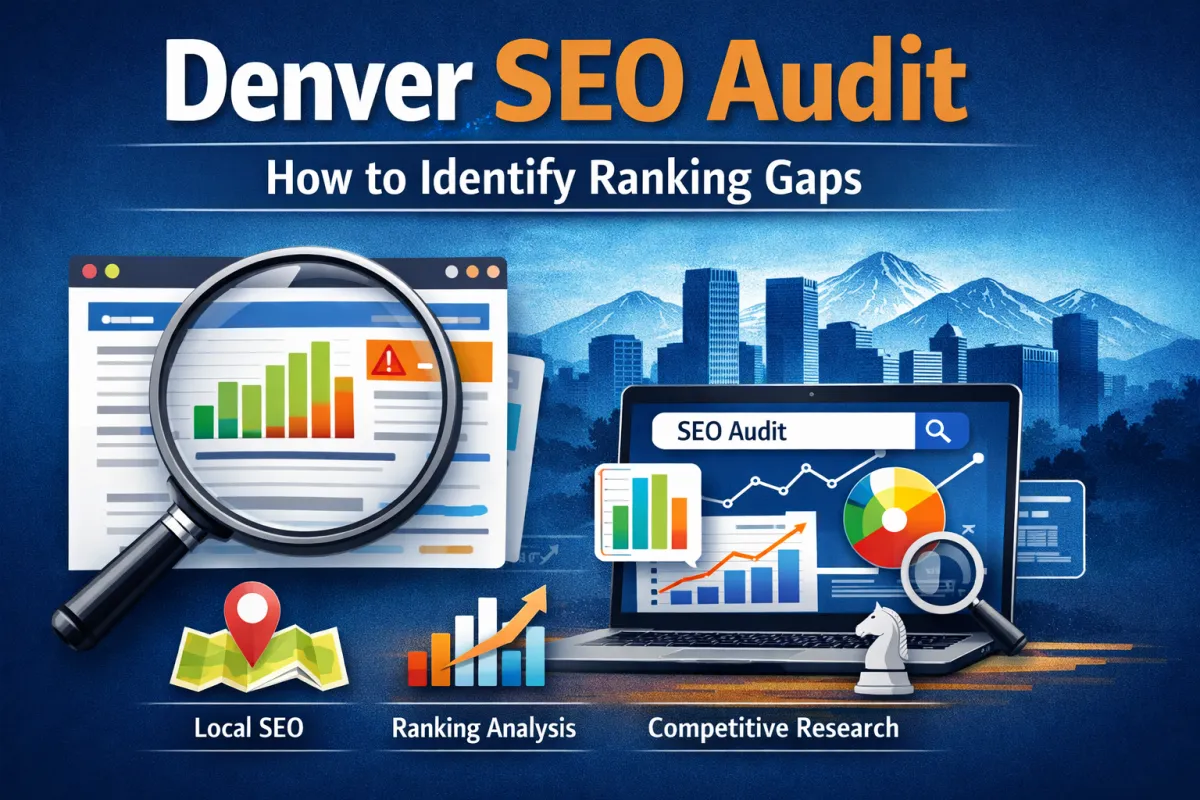
Denver SEO Audit: How to Identify Ranking Gaps
If your business is not showing up where it should in search results, a proper Denver SEO audit can help uncover what is actually holding your website back. Whether you run a local service business, law firm, clinic, contractor company, or retail brand, understanding your search visibility is the first step toward stronger rankings and better leads. A detailed local SEO audit should go beyond surface level checks and identify the exact gaps between your website and the competitors already ranking above you.
What Is a Denver SEO Audit?
A Denver SEO audit is a full review of your website's SEO performance, local visibility, technical health, content quality, and competitive positioning. It helps you find the weaknesses that may be affecting your organic traffic, local rankings, Google Business Profile visibility, and conversions.
A professional SEO audit service should evaluate both your website and your local SEO presence together. That means looking at your on-page SEO, technical issues, keyword targeting, Google Business Profile, citations, backlinks, content coverage, and overall user experience, not just one piece in isolation.
Why Ranking Gaps Matter
Ranking gaps are the missed opportunities between where your business sits now and where it could realistically be in Google search results. These gaps often show up when competitors are simply doing certain things better, whether that is targeting stronger local keywords, publishing more useful content, earning better backlinks, or keeping a stronger Google Business Profile.
If you are not actively identifying those gaps, your business may keep losing traffic and leads to competitors who are just more visible online. A focused local SEO audit helps reveal where those missed opportunities exist and what actually needs fixing first.
Signs Your Website Has SEO Gaps
Many businesses do not realize they have SEO issues until leads drop or rankings become unstable. A site not ranking for key Denver based search terms, competitors consistently appearing above you in maps and organic search, traffic that has declined for no clear reason, service pages that are not generating leads, and a Google Business Profile that is quietly underperforming are all common warning signs. A site that feels slow, outdated, or hard to use on mobile, or one that has content sitting on it without actually ranking or attracting local visitors, points to the same underlying problem.
Every one of these is a sign that a real audit could uncover important technical, content, or local SEO issues sitting beneath the surface.
Step 1: Review Your Current Keyword Rankings
The first step in identifying ranking gaps is checking what your site already ranks for. Look at your current positions for your main service keywords, location based keywords, and long tail searches tied to your business.
For example, a roofing company in Denver should know exactly how their site performs for searches like roofing company Denver, roof repair Denver, emergency roofing Denver, and best roofing contractor in Denver.
A proper audit should not only show what you rank for right now, but also what you should be ranking for and are currently missing entirely.
Step 2: Compare Your Website with Local Competitors
A ranking gap audit should always include real competitor analysis. Search your main keywords and review the websites sitting on page one. Compare their site structure, content depth, service pages, backlinks, FAQs, reviews, and local relevance against your own.
Worth asking directly: do competitors have more detailed service pages, are they targeting more Denver neighborhoods or nearby areas, are they publishing blog content built around local search intent, is their Google Business Profile stronger than yours, and do they have better internal linking and calls to action.
A strong audit process helps you see exactly why competitors are outranking you, and where your own website genuinely needs work.
Step 3: Audit On-Page SEO Elements
On-page SEO is one of the most important areas to review during any SEO audit. Even a well designed website can struggle if its pages are not properly optimized underneath the surface.
Page Titles and Meta Descriptions
Each important page should carry a unique, keyword focused title and meta description, clearly mentioning your service and Denver location where it makes sense.
Heading Structure
Your page should use one clear H1 heading, backed by organized subheadings that genuinely support the main topic.
Keyword Placement
Relevant keywords should appear naturally in titles, headings, opening paragraphs, image alt text, and throughout the body content, without ever feeling forced or repeated for its own sake. According to Google's own SEO documentation, content written for actual readers, not search engines, tends to perform better over time than pages built purely around exact keyword repetition.
Internal Linking
Relevant pages should link to one another, helping search engines understand your site structure while also improving how visitors actually navigate your site.
Content Quality
Thin, duplicated, or overly generic content creates major ranking gaps on its own. Your pages need to be genuinely useful, location relevant, and written to match what the reader is actually looking for.
Step 4: Check Local SEO Signals
A business targeting Denver customers has to pay close attention to local SEO specifically. A website can look fine overall while still missing crucial local signals that impact map rankings and local visibility.
Google Business Profile Optimization
Make sure your profile is fully filled out with the correct business name, primary category, services, description, contact details, hours, and photos.
NAP Consistency
Your business name, address, and phone number need to match exactly across your website, Google Business Profile, and every local directory listing.
Local Citations
Check whether your business is listed accurately across trusted directories and local business platforms.
Reviews and Reputation
Customer reviews shape both trust and local rankings. Look closely at your review quality, frequency, and how consistently you respond.
Local Landing Pages
If you serve multiple areas around Denver, dedicated location pages built around those specific places can make a real difference.
Step 5: Identify Technical SEO Problems
Technical issues often create hidden ranking gaps that never show up in a quick glance. A website can have strong services and decent content while still underperforming, simply because search engines cannot crawl, index, or trust the site properly.
A complete audit should check for slow page speed, mobile usability issues, broken links, crawl errors, indexing problems, duplicate content, missing canonicals, redirect chains, thin pages, a missing XML sitemap, and poor Core Web Vitals.
Technical fixes often build the actual foundation needed for stronger rankings and better local visibility down the line.
Step 6: Review Content Gaps
Content gaps show up when your competitors have pages or topics that your website simply does not. If searchers are looking for answers, services, comparisons, pricing details, or location specific information and your site does not provide it, Google tends to favor a competitor who does.
Common examples include missing service pages, no blog content built around local questions, no FAQs tied to Denver search intent, no pages for neighborhoods or surrounding service areas, and no trust building content like case studies or testimonials.
A smart audit should highlight exactly which content pieces need to be added, improved, merged, or expanded.
Step 7: Analyze Backlink Strength
Backlinks remain a genuinely important ranking factor. If competing Denver businesses hold stronger local links, industry mentions, and citation authority, they may outrank you even when your site looks just as strong on the surface.
During your audit, look at how many referring domains your site actually has, whether you hold any real local backlinks, the quality of the sites linking to you, any spammy or toxic link patterns, and where competitors clearly hold a backlink advantage over you.
If your site is genuinely lacking authority, backlink building likely needs to become part of your broader SEO growth plan.
Step 8: Measure Conversion Gaps Too
An SEO audit should never focus on rankings alone. It should also review whether your traffic can actually convert into calls, form submissions, or booked appointments. Sometimes the ranking gap is not the only problem. A site can attract visitors and still fail to turn them into real leads.
Check whether your site has clear calls to action, easy contact options, strong trust signals, fast loading mobile pages, genuinely helpful service information, simple forms, and click to call functionality.
A quality audit connects SEO performance directly to real business results, not just rankings on a report.
Common SEO Gaps for Denver Businesses
Many local businesses in Denver run into the same recurring issues. Targeting broad keywords with no local intent, weak Google Business Profile optimization, poor citation consistency, thin service pages, a lack of neighborhood specific content, slow mobile performance, missing schema markup, limited backlink authority, low review activity, and an outdated website structure show up again and again.
These problems can create a real, meaningful gap between your site and the competitors currently dominating search results.
What to Do After the Audit
Once your Denver SEO audit is complete, the next step is prioritization. Not every issue carries the same weight, so start with whatever fixes can make the biggest impact first.
That usually means focusing on technical errors affecting crawlability and indexing, key service page optimization, Google Business Profile improvements, NAP and citation cleanup, content gap expansion, internal linking improvements, review generation and local trust signals, and authority building through backlinks, roughly in that order.
This creates a practical roadmap to actually follow, rather than a random list of SEO tasks with no real sequence behind it.
Why Work with a Professional SEO Audit Service in Denver?
Some SEO issues are easy to spot on your own, but a lot of ranking gaps genuinely require deeper analysis. A professional SEO audit service can give you a much clearer picture of what is actually happening, why your rankings are stuck, and which actions are most likely to move the needle.
Instead of guessing, you get a real, data based plan focused on your local market, your actual competitors, and your specific business goals. That matters even more if your business depends on local leads and wants to grow consistently within Denver search results.
Final Thoughts
A proper Denver SEO audit is one of the smartest ways to identify ranking gaps and improve your online visibility. It shows you exactly where your website stands, what competitors are doing better, and which issues are actually stopping your business from ranking higher.
If your goal is better local traffic, stronger map visibility, and more qualified leads, a detailed local SEO audit is the right place to start. With the right insights and a real action plan behind them, your website can move from being overlooked to becoming a genuinely strong local search competitor.
Frequently Asked Questions
How long does a full Denver SEO audit typically take?
Most audits take anywhere from a few days to about two weeks, depending on the size of your website and how deep the review needs to go.
Can I do an SEO audit myself, or do I need a professional?
Basic checks are doable on your own, but a professional audit tends to catch deeper technical and competitive gaps that are easy to miss without the right tools and experience.
How often should my business get a new SEO audit?
Most businesses benefit from a full audit at least once a year, with smaller check-ins whenever rankings or traffic shift unexpectedly.
Will an SEO audit tell me exactly why I am losing leads, not just rankings?
Yes, a good audit looks at conversion issues too, not just rankings, since a site can attract visitors and still fail to turn them into actual leads.
What happens after the audit is finished?
You get a prioritized action plan, starting with the fixes likely to make the biggest difference first, so the work that follows has a clear order instead of feeling random.


